.png)
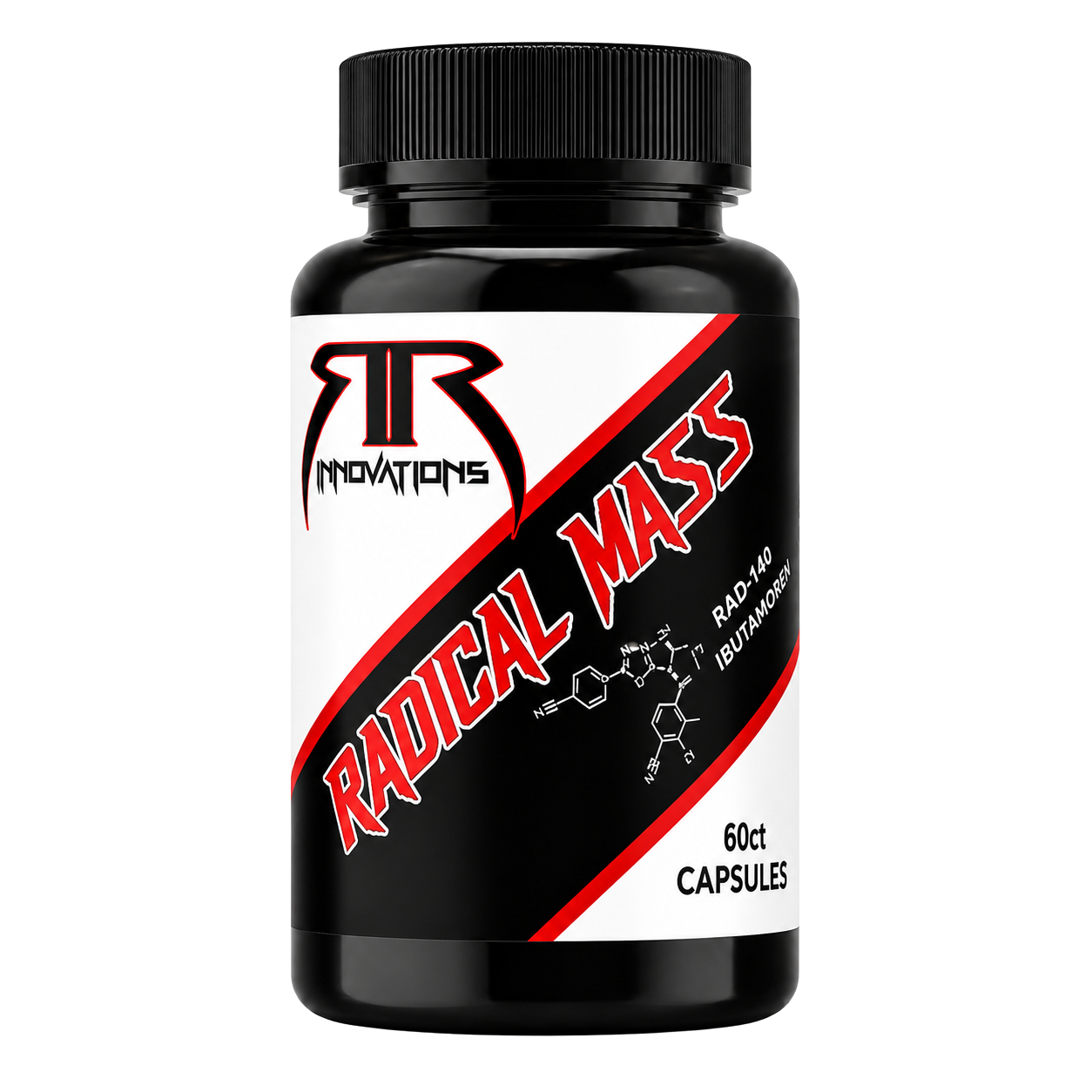
Radical Mass
$99.99
In stockRadical Mass is a three-compound research formulation containing 10 mg of RAD-140, 12.5 mg of MK-677, and 2.5 mg of Noopept.
| SKU | RC-RA-RADMASS-60CT |
|---|---|
| Manufacturer | R+R Innovations |
| Form | Capsule |
| Strength | 10 mg (RAD-140), 12.5 mg (MK-677), 2.5 mg (NOOPEPT) |
| Size | 60 count |
| Reported Result | Supplier spec pending verification |
| Stock | In stock |
| Documentation Status | Pending Final COA |
Product Description
Radical Mass is a multi-pathway research formulation combining three investigational compounds with distinct molecular targets. The blend features 10 mg of RAD-140, 12.5 mg of MK-677, and 2.5 mg of Noopept.
Although sometimes broadly categorized as a SARM blend, only RAD-140 is conventionally classified as a selective androgen receptor modulator. MK-677 is a ghrelin-receptor agonist and growth-hormone secretagogue, while Noopept is a synthetic, peptide-derived research compound. The three ingredients consequently represent separate areas of androgen-receptor, neuroendocrine, and neurological research.
RAD-140 — 10 mg
RAD-140, also known as Testolone, is an investigational, nonsteroidal selective androgen receptor modulator. Its principal molecular target is the androgen receptor, a ligand-activated nuclear receptor involved in regulating the transcription of androgen-responsive genes.
After binding, RAD-140 induces a conformational change in the androgen receptor. The activated receptor can interact with transcriptional coregulators and specific DNA sequences called androgen-response elements. This process can alter gene-expression patterns, although the resulting response depends on factors such as tissue type, receptor density, coregulator availability, exposure, and metabolism.
RAD-140’s nonsteroidal molecular structure distinguishes it from testosterone and conventional anabolic-androgenic steroids. It is not a precursor to testosterone, and its primary pharmacology does not depend on conversion into testosterone. Preclinical research has characterized RAD-140 as a potent androgen-receptor ligand with comparatively low activity at several other steroid-hormone receptors.
The term “selective” describes the research objective of producing different patterns of androgen-receptor activation among tissues. It does not mean that the compound acts exclusively in skeletal muscle or that systemic androgenic and endocrine activity is absent. Tissue selectivity also should not be interpreted as evidence of safety.
RAD-140 has been investigated in cellular and animal models, as well as limited early-stage human clinical research. It remains investigational and has no FDA-approved use.
MK-677 — 12.5 mg
MK-677, commonly called Ibutamoren, is an orally active, nonpeptide growth-hormone secretagogue. It is not a SARM and does not principally act through the androgen receptor.
Its primary identified target is the growth-hormone secretagogue receptor type 1a, more commonly called the ghrelin receptor. This G-protein-coupled receptor is expressed in the hypothalamus, pituitary gland, and several peripheral tissues. Ghrelin is its principal endogenous ligand.
By acting as a ghrelin-receptor agonist, MK-677 can engage neuroendocrine signaling involved in pulsatile growth-hormone release and downstream insulin-like growth factor pathways. The ghrelin receptor also participates in appetite regulation, glucose homeostasis, gastrointestinal activity, sleep-related signaling, and broader energy-balance processes. Its pharmacology therefore extends beyond a single hormone or tissue.
Unlike peptide-based growth-hormone secretagogues, MK-677 is a nonpeptide small molecule developed for oral activity. Published human studies have examined its pharmacokinetic and endocrine effects, but clinical investigation does not constitute regulatory approval. Research has documented systemic changes involving growth-hormone signaling, appetite, glucose regulation, and fluid balance.
MK-677 is not growth hormone itself, nor is it an androgen-receptor agonist. It remains an investigational compound without an FDA-approved indication.
Noopept — 2.5 mg
Noopept—chemically N-phenylacetyl-L-prolylglycine ethyl ester and also known as GVS-111—is a synthetic, peptide-derived research compound. It is structurally related to the endogenous dipeptide cycloprolylglycine but is not a SARM, hormone, or conventional peptide hormone.
Its pharmacology has been explored predominantly through cellular and animal models. Published experiments have investigated possible effects involving glutamatergic neurotransmission, calcium signaling, cholinergic function, oxidative pathways, and the expression of neurotrophic factors. Researchers have also studied whether its metabolites contribute to its observed experimental activity.
No single molecular mechanism has been conclusively established as explaining all findings attributed to Noopept. Evidence from animal behavior, isolated tissue, or cell-culture models cannot be assumed to establish a particular cognitive or neurological outcome in humans.
Noopept is marketed as a pharmaceutical product in certain countries but is not an FDA-approved drug or recognized dietary ingredient in the United States. Controlled human evidence, comprehensive pharmacokinetic data, and research concerning its interactions with endocrine-active compounds remain limited.
Storage and handling: Keep sealed, dry, and protected from heat and direct light unless the final product label or COA states otherwise. Maintain the product with its matching batch record.
Third-party testing status.
| Batch / Lot | Reported Result | Tested | Partner | Status | Document |
|---|